
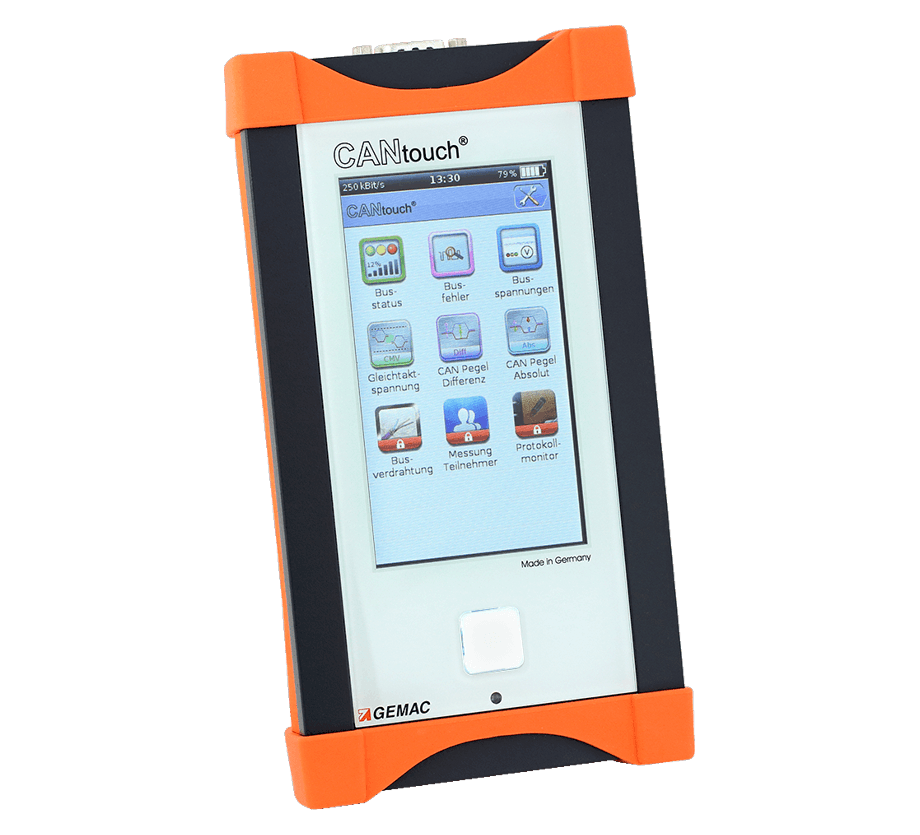
CANtouch® is a battery-operated handheld diagnostic device for the physical and logical analysis of CAN, CANopen, DeviceNet or SAE J1939 systems.
It is the portable variant of the CAN-Bus-Tester 2 (CBT2)
It is the portable variant of the CAN-Bus-Tester 2 (CBT2)
Features and Benefits
- Supported protocols: CAN, CANopen, DeviceNet, SAE J1939
- Baud rates (10 kBit/s ... 1 MBit/s)
- Measurements designed as Apps
- Bus Status (Bus traffic load)
- Bus Errors (Active and passive frame errors)
- Bus Voltages (CAN supply voltage and shield voltage)
- Common Mode Voltage
- CAN Levels (absolute / differential)
- Bus Wiring (Short-circuits, interruptions, loop resistances, cable length)
- Node Measurement (Quality level, Disturbance free voltage range, Edge steepness, Oscilloscope disp.)
- Protocol Monitor - Including six apps, additional apps via license
Fields of Application
- Commissioning of CAN bus systems
- Wiring test, module check
- Service/maintenance of CAN bus systems
- Troubleshooting and analysis of the bus characteristics
- Development of CAN modules
- Final testing in the production
Rental service
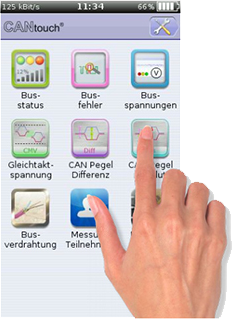
CANtouch is rented including support and problem analysis remotely by Twincomm. The minimum rental time is 2 weeks, but it can be extended on a weekly basis.
| Technical data | |
| Languages | English and German |
| Bussystems | CAN (ISO11898-2), CANopen (CiA301), DeviceNet (EN 50325-2), SAE J1939 |
| BUS status | Bus traffic detection (display: dominant, recessive, not defined, bus traffic) |
| Display of the bus traffic load (0 ... 100 %) | |
| Display of detected frame errors (active and passive error frames) | |
| Display of the optional CAN supply voltage and the shield voltage | |
| Common-mode | Recognition and measurement of the maximum voltage offset between the nodes |
| CAN levels | HRecognition and measurement of the differential and absolute CAN levels of all bus nodes during run-time |
| Bus wiring Opt | Recognition and measurement of line short-circuits, line breaks, bus termination, loop resistances and the overall line length |
| Node msrmnt Opt | Node-related physical measurement of: |
| - Quality Value (Value representing the signal quality 0 ...100%) | |
| - Disturbance-free voltage range and edge steepness | |
| - Oscilloscope display with frame analysis and full frame recording | |
| Protocol monitor Opt | Transmission and reception of CAN Messages |
| Baudrates | 10 - 20 - 50 - 100 - 125 - 250 - 500 - 800 - 1000 kbit/sec |
| User defined: 5 - 33,3 - 62,5 - 75 - 83,3 - 200 kbit/sec | |
| Automatic recognition via baud rate scan, bit timing adjustable | |
| Power | Built-in rechargeable lithium-ion battery |
| External power supply | |
| SELV DC 14 V; Operation only via included 35W power supply |
|
| Duration | |
| Stand-by: tot 500 hrs; | |
| Activated: Tot 36 hrs | |
| Measurements: up to 6 hrs; | |
| Charging | |
| Fast charge to 80 % in about 1 hr.; fully charged in about 2 hrs | |
| Housing | Aluminum housing, cover glass |
| Temperature | Operating temperature 5 °C ... 40 °C |
| Protection | IP20 according to EN60529 |
| Dimensions | 186 x 102 x 37 mm (H/W/D) |
| Weight | Appr. 860 gr |
Opt = Optional |
|
| Contents of delivery |
| CANtouch Basic Kit |
| - CANtouch with integrated lithium-ion battery |
| - Power supply, power cable (EURO), USB cable |
| - 2 manuals (German/English) |
| - 2 x CAN connection cables 0.3 m and 1.5 m |
| - 2 x T-adapter for 9-pin D-Sub and M12 |
| - 2 x Termination resistor 9-pin D-Sub and M12 |
| - 4 mm safety testing cable 3 m length with safety crocodile clip |
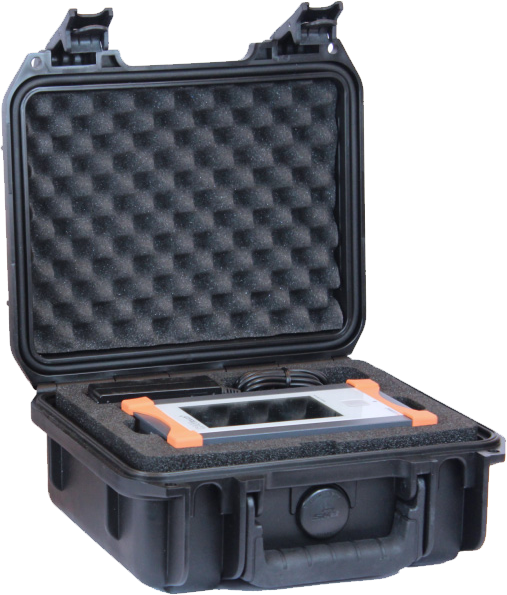
| - Case with foam for CANtouch, power supply, adapter set |
| CANtouch CANopen Bundle |
| - CANtouch Basic Kit |
| Software licenses for the activation of: |
| - CAN - Station-related physical measurement |
| - CANopen - Station-related physical measurement |
| - Bus wiring measurement |
| - CAN protocol monitor (transmit and receive |
| CANtouch deviceNet Bundle |
| - CANtouch Basic Kit |
| Software licenses for the activation of: |
| - CAN - Station-related physical measurement |
| - DeviceNet - Station-related physical measurement |
| - Bus wiring measurement |
| - CAN protocol monitor (transmit and receive) |